
On staying grounded in uncertain times with Dr Dougal Sutherland
Dr Dougal Sutherland is a clinical psychologist with more than 20 years of experience, an Adjunct Teaching Fellow at Te Herenga Waka–Victoria University of Wellington, and CEO of Umbrella Wellbeing. We spoke to Dougal about why so many people in Aotearoa are feeling stretched, overwhelmed, or tired right now – and what can help when the world feels uncertain.

Rising costs, global conflicts, climate-related events, the dramatic growth of artificial intelligence... Many New Zealanders are feeling worn down by the state of the world. What do you think people are carrying at the moment?
One term that's often used to describe the current environment is VUCA – volatile, uncertain, complex and ambiguous. It feels like a pretty accurate description of the world many people are experiencing right now.
We're constantly exposed to information about global conflict, economic pressures, climate events and rapid technological change. It can feel like there's always something else to worry about.
That ongoing uncertainty is exhausting. In our work, we see people who are tired, worn out and more irritable than they might usually be. When we're under sustained pressure, our emotional reserves get depleted and it becomes harder to regulate our emotions and cope with everyday challenges.
When life feels so uncertain, like it does for so many people right now, how can we find our footing again?
One of the things I really like about the All Sorts campaign is the idea that it's normal to experience all sorts of emotions during difficult or uncertain times. Nobody likes to experience uncomfortable emotions, but they're here, and it’s something that's present for lots of us. It’s okay to acknowledge and sit with them. You probably don’t want to live in that space the whole time, but even just camping there for a little while and acknowledging that it’s okay can help.
In fact, sometimes battling against those difficult emotions is just as tiring as allowing them to be there.
Talking to other people can also be incredibly helpful. When we share what we're going through, we often discover that others are feeling similar. That sense of connection and validation can make a real difference.
What practical things can people do when the world feels overwhelming?
One of the most useful approaches is to focus on what you can control.
A model I often use is the "circles of control". The outer circle represents the things that are of concern to us: for example, the state of the world, poverty and economic pressures. They’re definite concerns, but we can’t do very much about them. We often spend a lot of our time sitting in that circle of concern.
The middle circle is: what are the things we can influence? We can influence our social relationships. We can influence how we are with other people and the group dynamics we're part of – whether that’s at work, school or home.
Then, right in the centre, are the things we can control. The simple things: we can control the amount of information and notifications we get through our phones. We can control how we choose to be in the world.
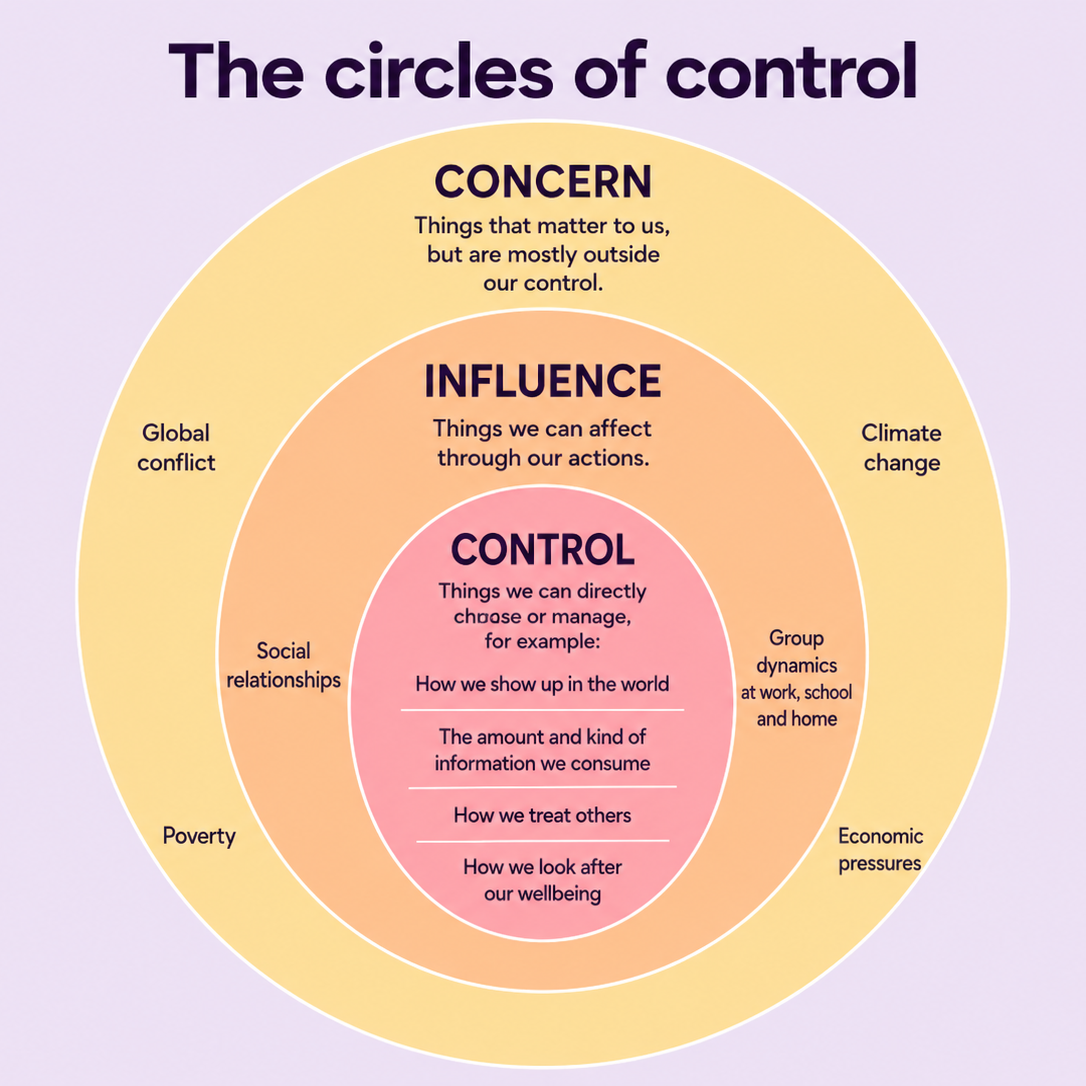
No matter how difficult things are, we can make a deliberate choice to live as closely as possible to the values that matter most to us.
How can we choose those values for ourselves?
Everyone’s values will be different, but it can be helpful to identify two or three that really resonate. I often ask people, “How would you like others to describe you as you go through this process?” The words that come to mind are often a good clue to the values that are important to you.
You can then use those values as a compass. You might think, “I feel really irritated in this situation. I feel overwhelmed, and I want to get angry. But I don’t want to act that way. I want to respond in a way that is more closely aligned with my values.”
Do you think that people need to give themselves a bit more grace and self-compassion? Irritability, frustration, or other unpleasant emotions can still get to us from time to time, even if we're actively working on responding to stressful events in a calmer, more controlled way.
Absolutely. I think often, particularly as New Zealanders, we can be pretty hard on ourselves. “You’ve just got to tough it out. Get on with it.” But actually, it’s okay to acknowledge that stuff is hard sometimes and to give yourself a break.
If a friend came to you feeling exhausted and overwhelmed, you probably wouldn't tell them to toughen up. You'd likely offer understanding and support. That is where self-compassion comes in: treating yourself with kindness and gentleness, especially when things are difficult.
Earlier, you mentioned managing how much information and news we allow into our lives. How can people stay informed without becoming overwhelmed?
It's about finding a balance.
I'm certainly not suggesting people ignore what's happening in the world, but most of us don't need constant updates throughout the day. Turning off notifications, limiting how often you check the news and being intentional about your social media use can all help.
I also think it's important to actively seek out positive stories and experiences. That's not about denying difficult realities. It's about remembering that difficult things and hopeful things can both exist at the same time.
Financial stress is a major concern for many households in Aotearoa right now, particularly with the ongoing fuel crisis. Why can money affect our wellbeing so deeply?
I believe it is a symptom of living in a Western society where everything (or almost everything) has a value attached to it. Money is tied to some of our most basic needs. It affects our ability to pay the bills, put food on the table and feel secure.
Because of that, financial uncertainty can create significant stress, anxiety and fear. It's a very human response.
One of the biggest mistakes people can make is becoming isolated. Financial pressure often comes with feelings of shame, which can make people withdraw from others. They may think, “Maybe I’m not worth much because I’ve been made redundant,” or “We’re struggling to cover the bills.” Those feelings can be incredibly difficult, but it is important not to let them push you into silence.
Where you can, be open about what you are going through. Seek support and advice, and share your experience with people you trust. That can be powerful: it can reduce stigma, remind you that you are not alone, and help you access practical support and ideas.
Please remember that financial hardship is not a personal failure. This is what is happening to many people in New Zealand and the world right now, and it is hard. You have not done anything wrong as a person, even though you may still be left dealing with the consequences.
If someone is feeling exhausted, overwhelmed or just disconnected, how can they reconnect with what matters to them?
Difficult periods can sometimes create an opportunity to reflect on what is truly important.
Many people move through life at a rapid pace without stopping to ask themselves what gives them meaning or purpose. Challenges can prompt us to revisit those questions.
For some, that might mean investing more time in relationships and community. For others, it might mean volunteering, helping others or reconnecting with interests that have fallen away.
It's also useful to remember that purpose doesn't have to come from paid work. What matters is feeling connected, valued and part of something bigger than yourself.
That can be really helpful for people’s sense of themselves: even though they may not have a job, or may be struggling with money, they can still have that sense of, “I’m personally valued for who I am and what I do, rather than the dollar value attached to me.”
Everyone has something to give, even when they may not feel like they do.
Many of us tend to put our own needs aside, especially when time and money are scarce. How can we encourage ourselves, and others, to keep looking after our wellbeing during tough times?
Often, it is the small steps we take and the everyday choices we make that matter most.
It can help to ask yourself: what is filling up my bucket? What is adding to my wellbeing and sense of purpose?
Your bucket might have a few holes in it at the moment, with stress and pressure draining your energy. The question is: how can you keep topping it up in small ways each day? What can you do, even briefly, that gives you a sense of meaning and connection?
Finally, what would you say to people who feel like they've run out of emotional bandwidth?
With any sort of emotional regulation, the first step is recognising it. For some people, that might mean being able to stop and be realistic with themselves: “Actually, I am exhausted.”
Sometimes we become so focused on getting through the day that we don't stop to notice how tired we really are. Naming what you're experiencing – whether it's stress, burnout, overwhelm or fatigue – can be a surprisingly powerful strategy.
From there, it's about giving yourself permission to recharge.
We're human beings. We have limits. Rest isn't something we earn after we've pushed ourselves to breaking point; it's something we need in order to keep going.
Whatever metaphor works for you – a marathon, a long journey, a difficult season – the principle is the same. We all need moments to pause, recover and replenish our energy. Sometimes it’s okay to stop and take a break.
Share this page
You may also be interested in


There is no health without mental health
Help ensure everyone in Aotearoa has the tools to enjoy positive mental health and wellbeing.

Did you find this product page useful?