Skip to main content Skip to footer

What Doocey’s strategy needs to deliver

Our call for an accurate, actionable and achievable mental health strategy, funded in line with need.

We all know Aotearoa New Zealand’s mental health system is under immense strain and pressure.

Despite high and growing mental health need, New Zealanders often can’t access timely and appropriate mental health care. Many mental health workers are under-resourced and over-worked, with many desperately trying to provide quality care in a system that often doesn’t support them to.  

Despite these issues, Aotearoa doesn’t have an actionable strategy to address them. The Mental Health Foundation has called for a plan to address the mental health system’s woes repeatedly, for at least the last five years.

Why isn’t there an actionable strategy

It’s not clear why multiple past governments haven’t developed a consistent, actionable mental health system strategy. Various mental health and addiction inquiries, reports and frameworks have been released since 2018 to improve the mental health system, but without a plan to action them, their brilliant insights lie largely under-utilised.

Our best blueprint for mental health system transformation so far remains 2018’s He Ara Oranga. This report of the Government Inquiry into Mental Health and Addiction voiced solutions from thousands of New Zealanders, and called for the Government to both protect and improve mental wellbeing, whilst supporting people with mental distress. 

Other reports and frameworks such as:

have also been delivered since. While equity-driven and grounded in strong values, these reports and frameworks are also largely aspirational – difficult to measure, lacking clear accountabilities, and failing to address the root causes of the issues the mental health system faces.

Why is a mental health system strategy needed?

While some improvements have resulted from these inquiries, reports and frameworks, overall mental health system progress has been slow and fragmented, with significant gaps still remaining in key areas. In some cases, the high-level, piecemeal actions delivered so far have merely shifted problems from one area of the system to another. This, along with decades of underfunding and under-resourcing across successive governments, has contributed to the ailing mental health system we have today. 

We anticipated this outcome after the government accepted 38 of He Ara Oranga’s 40 recommendations for mental health system transformation, but failed to produce an action plan to implement them. Without accurate, actionable, and achievable detail to translate these insights into change, decision-makers have delivered the positive, but ultimately piecemeal, actions we’ve seen to date. In other words, without an actionable, whole-of-system plan, our mental health system can plan to fail.

Our current Minister of Mental Health, Hon. Matt Doocey, appears to agree. In his own words, Aotearoa’s mental health system needs less "vision statements, working groups and nice words" and more tangible, lasting, meaningful change. 

What’s happening now?

After years of advocacy, Hon. Doocey is now legally required to deliver a mental health system strategy by November this year. Tau kē!

This is due to the Pae Ora (Improving Mental Health Outcomes) Amendment Bill passing at the end of 2024.

Legally mandating a mental health strategy is wise. It ensures:

  • Aotearoa’s mental health strategy will have equal standing with other health strategies (such as Māori, Pacific peoples, women’s, disabled peoples, and rural strategies)
  • The government of the day will be held accountable for the transformation of Aotearoa’s mental health system
  • There will be an enduring, long-term focus on the solutions needed to support mental health system transformation.

Developing this actionable strategy is Doocey’s chance to make our mental health system shine. 

What Doocey needs to deliver

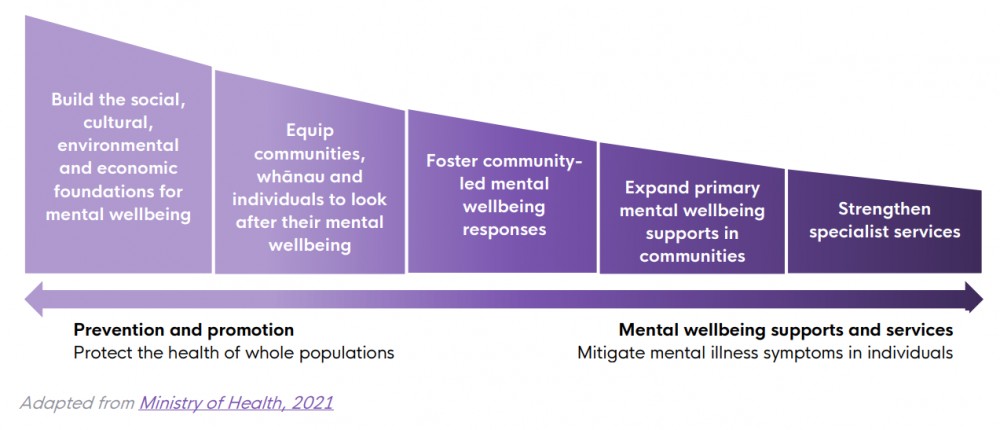
Hon. Doocey needs to deliver a mental health system strategy that does two key things. Firstly, Doocey’s strategy needs to spread focus and investment evenly across the three ‘P’s: Promoting mental health and wellbeing Providing earlier responses and interventions for people in distress Preventing poor mental health and wellbeing.

This approach has widespread support from both within and outside the mental health sector, and is echoed out in the holistic, population-based mental wellbeing framework (see below).

MOH diagram

Doocey’s mental health strategy also needs to embody the three ‘A’s, by being:

  • Accurate: Correctly identifying the areas of need, such as addressing youth mental health, access to specialist mental health services and growing the mental health (including peer) workforce, and addressing those needs without adversely affecting other areas of the mental health system
  • Actionable: Delivering clear actions, timeframes, milestones, and the names of people or agencies responsible for delivering work 
  • Achievable: Earmarking specific budget towards the actions in this strategy in Budget 2025 and future budgets, in line with mental health need.

17 key actions Doocey’s strategy needs to deliver

We’ve developed 17 key actions, split across five areas, that Doocey’s strategy can focus on to ensure he achieves the three ‘P’s, and the three ‘A’s. In essence, we (and thousands of New Zealanders contributing to the inquiries, reports and frameworks our recommendations lean upon) have taken the hard work out of it for him. Will Doocey take up the wero/challenge and ensure his mental health strategy delivers for all of Aotearoa?

Fund and invest

Aotearoa’s last comprehensive mental health and addiction prevalence survey was conducted 20 years ago. It’s impossible to truly understand the scale of national mental health need using data this old, and the way other mental health service data is collected and reported on doesn’t tell us, either. The MHF supports calls from He Ara Oranga and sector experts for investment in collecting and integrating high-quality, timely, nationally-consistent mental health data that covers services, workforce, and use of the Mental Health Act“. It’s great to see that design work is underway for a child and youth mental health prevalence study – we recommend Doocey’s strategy expands this study in the future to include other populations, and conducts a comprehensive nationwide prevalence study in the long-term.”

Aotearoa’s mental health system has been underfunded for decades. Doocey’s strategy needs to deliver integrated, ongoing investment to address the poor mental health outcomes this has created, commensurate to the scale of mental health need. Communities who experience disproportionate levels of discrimination and/or disadvantage contributing to poorer mental health outcomes (such as Māori, Pasifika, Asian peoples, migrants, people with a background as refugees, people with disabilities, Rainbow communities, children and youth, and rural populations) should be included in funding decision-making processes.

The Mental Health Act, the law people can go under when in acute distress, is being replaced by a new Mental Health Bill. Positive changes in the Bill, such as embedding ‘supported decision-making’ (or helping people in acute distress to make their own decisions) and reducing and eventually ending seclusion (where someone is placed in a bare room with only a cardboard toilet and mattress, often for long periods of time) will need targeted investment within Doocey’s strategy to become a reality. 

We will never solve Aotearoa’s mental wellbeing crisis one person at a time – we need a public health approach. Mental wellbeing promotion programmes improve lives, prevent crises, relieve pressure on services and save money, with many showing return on investment after only a short period of time. But without adequate planning and funding, their success, reach and benefits are stifled. Non-government organisations (NGOs) and other community-based groups (like kaupapa Māori organisations) are well-placed to deliver relevant mental health promotion initiatives, but are currently under-utilised. We recommend Doocey’s strategy includes a plan for mental wellbeing promotion, and provides on-going funding that has equitable impacts across communities. 

Grow the workforce and community partners

Severe workforce shortages are limiting access to quality mental health care, particularly in specialist services. As outlined in Health NZ's Mental Health and Addiction Workforce Plan 2024 – 2027 (2025 refresh), targeted investment is needed to expand training pathways, improve staff retention, and increase support for specialist clinicians. Our mental health workforce also needs to be more representative of (and effective and culturally safe for) our diverse communities, including Māori, Pasifika, Asian communities, people with disabilities, migrants, people with backgrounds as refugees, and Rainbow communities, to prevent the inequitable care and poorer outcomes these communities face.

To alleviate pressure on the mental health system and ensure mental health policies and services are responsive to the people they serve, Doocey’s strategy needs to show a strong commitment to grow the consumer, peer support, and lived experience (CPSLE) workforce. Specifically, we recommend his strategy embeds lived experience wisdom through co-design; supports lived experience co-governance of mental wellbeing services and initiatives; and invests in pathways to develop and progress lived experience leaders (particularly tāngata whaiora Māori) to decision-making roles, enabling them to design and deliver solutions and pathways to grow the lived experience workforce. 

Māori experience some of the poorest mental health and wellbeing outcomes in Aotearoa, which are contributed to by the ongoing impacts of racism and colonisation, and inequitable access to culturally appropriate mental health care. Māori are also disproportionately subjected to traumatic practices (such as seclusion under the Mental Health Act), a breach of Te Tiriti o Waitangi obligations. We recommend Doocey’s strategy embeds kaupapa Māori approaches to mental health and wellbeing that reflect whānau, hapū, and iwi aspirations, prioritise Māori-led solutions, and respond to holistic wellbeing needs. We also recommend scaling up successful initiatives, such as Whānau Ora community-based programmes and kaupapa Māori mental health services, to ensure wider reach and impact.

Non-governmental organisations (NGOs) are essential partners in delivering government-funded mental health, addiction, and wider health and social services, as they best understand the communities they serve. However, the lack of true collaboration with government, funding insecurity, high compliance costs, and fragmented procurement practices undermine the sector's sustainability and its ability to innovate. A shift toward high-trust commissioning, with a focus on outcomes rather than outputs, is needed. We recommend Doocey’s strategy addresses these longstanding issues through practical changes in the short term – such as piloting flexible, mutually-accountable contracts that reduce compliance burdens and enhance collaboration.

Provide earlier responses to distress

Half of all lifelong mental distress or illness begins by age 14, and three-quarters by age 24, with many conditions diagnosed only after they’ve become harder to treat. Responding to mental distress early is crucial, and interventions can be targeted to young people with initiatives like Youth One-Stop Shops (YOSSs) and integrated youth services. We recommend Doocey’s strategy implements the Auditor-General’s suite of recommendations to improve youth mental health; and delivers whole-of-school programmes to teach wellbeing and peer support skills from a young age. 

The Access and Choice programme has made primary and community mental health care more accessible, for people with mild to moderate distress, over the last five years. Early intervention through this programme has also shown positive outcomes, including potentially reducing referrals to specialist services. While this workforce has grown, significant shortages remain in general practice, putting strain on the mental health system overall. Doocey’s strategy will need to expand primary mental health care services (as planned) and address workforce vacancies to ensure this care is timely, comprehensive and meets demand. 

Support people with mental distress, and people in crisis

Right now, it is very difficult for people with moderate to severe distress to access specialist services. As people wait, demand rises and needs become more complex, leading to people with the highest needs being prioritised by the stretched workforce available. Doocey’s strategy needs to expand specialist mental health services, including forensic mental health, perinatal and maternal mental health (such as by increasing the number and capacity of mother and baby units) and services for people with co-existing substance use disorders; ensure equitable access by prioritising Māori, Pasifika, disabled people, children and youth, and rural communities, who experience the greatest barriers to specialist care; and improve integration and referral pathways between primary, community, and specialist services to prevent people from falling through the gaps.

People experiencing mental distress or illness and/or addictions are two to three times more likely to die before the age of 65 than people without those challenges. Two-thirds of these deaths are due to preventable physical illnesses, such as cardiovascular disease and cancer. Rates of other illnesses, such as respiratory diseases and diabetes, are also higher for these groups. We recommend Doocey’s strategy ensures people with distress and addictions receive equitable care, such as through better integrating mental and physical health care pathways; improving collaboration between primary and secondary care; and increasing support and training for a range of health professionals. 

People in crisis require timely, empathetic mental health support. We support the ongoing delivery of multi-agency co-response teams (designed to safely attend mental health callouts) and peer support roles in emergency departments (to help people in distress navigate the system), but initiatives like these must be greatly expanded before Police can safely withdraw from attending mental health crises. We recommend Doocey’s strategy build on the plan to support Police withdrawal; fund community providers to deliver wraparound crisis care (including kaupapa Māori solutions); and expand urgent support through telehealth, mobile teams, and walk-in crisis services. We also recommend strengthening crisis de-escalation training for frontline responders; increasing the availability of alcohol and drug harm reduction education; and investing in more detox facilities. 

There is strong evidence that integrating employment and mental health services benefits people experiencing mental health challenges, particularly people who have accessed (or are accessing) specialist mental health services, or who have been unemployed for long periods. Integrating housing, employment and mental health supports also produces long-term cost savings and better outcomes. We recommend Doocey’s strategy explores integrating housing, employment and mental health initiatives in a way that prioritises community partnerships, co-designs solutions, and is culturally responsive and sustainable. 

Individual approaches to care overlook the fact that people exist within whānau and communities, where support networks play a crucial role in healing and recovery. Doocey’s strategy must expand access to support, information, advice, and guidance to whānau, to ensure they have the resources they need to effectively support their loved ones in distress and look after their own wellbeing. Investment in community-led initiatives that strengthen whānau-based care, including kaupapa Māori approaches and holistic maternity support, is also needed.

Prevent poor mental health and wellbeing

Every year, hundreds of people in Aotearoa die by suicide. For every suicide, an average of six people experience intense grief, and 129 people are affected. Doocey’s strategy needs to support the actions under Every Life Matters – He Tapu te Oranga o ia Tangata: Suicide Prevention Strategy 2019–2029 and the upcoming Suicide Prevention Action Plan 2025-2029 to be delivered. Particularly, investment is needed in sustainable, community-led suicide prevention and postvention initiatives that are safe and culturally responsive, support bereaved whānau, reduce distress and prevent further harm.

Evidence shows preventing poor mental health is one of the most cost-efficient, effective ways to reduce pressure on the mental health system and improve population wellbeing. But as poor mental wellbeing is heavily influenced by social determinants (such as access to housing, employment, education, and safe family environments), only a cross-government approach will ensure success. We recommend Doocey’s strategy establishes clear, measurable ways to drive cross-government collaboration; and holds all relevant government strategies and work programmes accountable for improving mental wellbeing outcomes, by setting common investment goals and integrating systems to assess collective impact. 

Like what you see?

Enjoyed what you read? To hear more about the mental health system advocacy work we carry out, join our free e-newsletter mailing list below. We won’t email you about anything else.

Join our mailing list

Want to support our work?

This advice to Hon. Doocey, and all of our policy and advocacy advice, is independent of government and political parties, and is supported by our wonderful fundraisers across the motu — ngā mihi nui ki a koutou. 

Share this page

There is no health without mental health

Help ensure everyone in Aotearoa has the tools to enjoy positive mental health and wellbeing.

Was this page useful?

We use cookies to improve your experience, analyse site traffic, and personalise content. By clicking "Accept", you agree to our use of cookies.