Skip to main content Skip to footer

Suicide Media Response Service

Language is an important part of suicide prevention. We engage and work with media and content creators to ensure suicide is safely talked about in Aotearoa.

How suicide is reported can be critical to preventing it. When high-profile stories about suspected suicide are spread widely, more suicides can follow. Media have the power to help prevent suicide by sharing stories about people overcoming suicidal crises, which can increase hope and decrease risk. 

Responsible reporting by media about suicide is a critical part in suicide prevention. 

Our work helps ensure stories about suicide provide messages of hope and recovery and increase understanding. 

  • Offer advice on how to talk, post or report safely about suicide-related topics 

  • Advise on initial concepts and storylines 

  • Give feedback on scripts 

  • Issue media advisories for breaking news stories that may be suicide-related 

  • Guide language about suicide to avoid stigma and stereotypes 

  • Provide workshops and presentations for workplaces, journalism schools and other tertiary providers. 
Everyone has a role to play in suicide prevention

The media holds the power to greatly help, or hinder, suicide prevention efforts.  

Widely disseminated stories of high-profile suicides can be followed by more suicides in the general population. 

Likewise, simplifying the causes of suicide or portraying suicide as a common reaction to tough times can normalise suicide, put  people at risk (if they identify with that cause or person) and contribute to misunderstandings about how suicide can be prevented.  

Best practice is to both reduce the prominence of stories about suicide and include stories of how people overcame a suicidal crisis.  

When the media focuses stories on suicide with themes of hope, resilience and overcoming crises, it helps provide people with a path through their own crisis. By sharing stories of people who have found strength through struggle, the media can inspire a culture of support and recovery. 

“Although suicide is a rare event statistically, a death by suicide has an impact that is often far-reaching. It can ripple beyond those who were immediately connected with the person who died.” Mark Wilson, Suicide media response service 

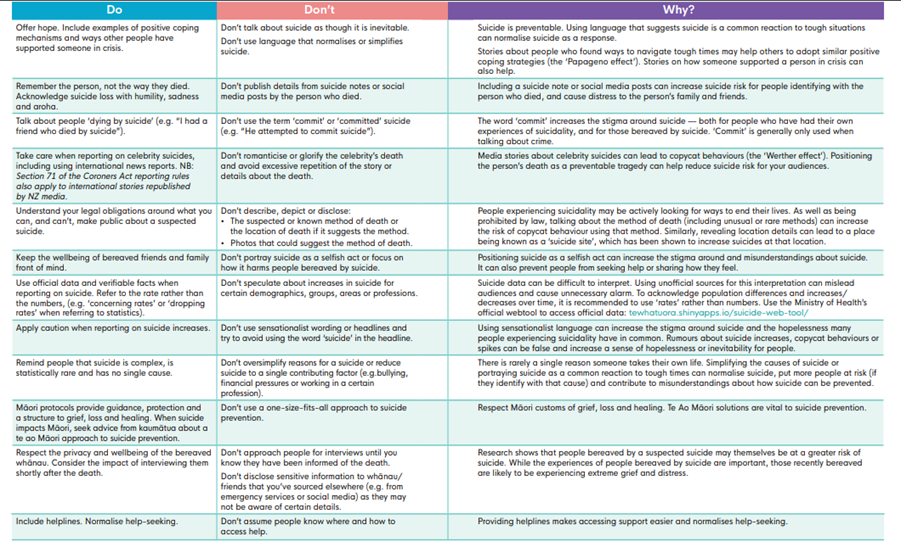
When communicating about suicide:

  • use safe, inclusive language 

  • only share confirmed information 

  • Don't mention method and location details 

  • include help-seeking information. 

Section 71 of the Coroners Act 2006

There are legal restrictions in Aotearoa New Zealand on what can be made public about a suicide or suspected suicide.  

These restrictions are listed in Section 71 of the Coroners Act 2006.Unless you have an exemption from the chief coroner, you can’t make public:  

  • The method or suspected method of the death.  

  • Any detail (e.g. the place of death) that might suggest the method or suspected method of the death.  

  • A description of the death as a suicide before the coroner has released their findings and stated the death was a suicide (although the death can be described as a ‘suspected suicide’ prior). 

‘Making public’ doesn’t just mean reporting it in the media - it also includes making public statements, posts on social media and/or in any correspondence.  

Until the death has been certified by the coroner, it must be referred to as a ‘suspected suicide’ or, if it was an unexplained or ambiguous death, a ‘sudden death’. 

For more information about the Coronial Services of New Zealand visit coronerscourt.govt.nz/suicide 

Guidelines for suicide media reporting

Guidelines for suicide media reporting were updated in 2021 by the Suicide Prevention Office, in collaboration with media outlets, Broadcasting Standards Authority (BSA), Media Freedom Committee and the Media Council.

  •  descriptions of suicide methods   

  •  dramatic headlines (including terms like ‘surge’, ‘spike’, ‘crisis’, ‘epidemic’)   

  • repetitive reporting   

  • reporting that depicts suicide as inevitable   

  • reporting that reinforces myths about suicide. 

For more information about the Guidelines for suicide media reporting visit www.health.govt.nz/publications/media-guidelines-for-reporting-on-suicide 

How to talk about suicide safely

The Papageno and Werther effects

Using safe images

It’s important to consider what’s being depicted in the image and how it may be viewed by audiences.

The images or video footage that go with a news story or social media post about a suicide or content relating to suicide are equally important. They also need to be consistent with the above language guidelines, and the law.

•    Are not graphic or distressing.
•    Don’t indicate a specific suicide method or location of the death.
•    Don’t reinforce unhelpful stereotypes (e.g. head-clutcher, showing someone isolated or in visible distress.).

Think about the impact on the whānau, friends and wider community of the person who died before including images or content from their social media accounts. You should always seek permission before accessing images.

•    Convey a sense of belonging or community (e.g. whānau, people working together or being connected)
•    Convey a sense of hope, healing, and recovery (e.g. showing someone being supported)
•    Reinforce the message that no one is alone, that help is available and that everyone’s life matters (e.g. include helplines and hopeful images, like a sunrise).

Digital platforms

We recommend media outlets and social media moderators hold specific policies around posting and monitoring suicide-related articles/items on all their digital platforms.

  • Actively monitor the comments sections and limit the ability to add comments or share the post. Or consider turning the comment option off
  • Avoid giving the story extra prominence and repetition
  • Focus on the person not their death
  • Ensure that no images show the location or method of death
  • Limit ongoing coverage of celebrity deaths. Avoid using sensational headlines or glorifying or romanticising the story
  • Include free helpline information.

Current evidence does not suggest that content warnings are effective in mitigating mental health risks of portraying suicide or self-harm. Content warnings should never replace careful and responsible crafting of messages of self-harm. — The Media and Internet Special Interest Group of the International Association for Suicide Prevention.

Include helplines

To help people know who to contact if they need support, we recommend including free helplines when publishing stories or posts about suicide or mental distress.

Ideally include the following free helplines with your coverage, but if you can only include one, please use 1737.

  •       Need to talk? Free call or text 1737 any time for support from a trained counsellor.
  •       Lifeline 0800 543 354 (0800 LIFELINE)
  •       Youthline 0800 376 633, free text 234, webchat at youthline.co.nz, DM on Instagram @youthlinenz, WhatsApp message on 09 886 5696
  •       Samaritans 0800 726 666
  •       Suicide Crisis Helpline 0508 828 865 (0508 TAUTOKO)
  • We also recommend including:
  •       Aoake te Rā - A free service providing support and manaaki to people who have lost someone to suicide. Visit www.aoaketera.org.nz
  • Visit mentalhealth.org.nz/helplines for a wider list of helplines.

Stigma and suicide myths

Myths and stigma around suicide continue to exist. They can frame beliefs and attitudes and make it harder for people to seek help when they need it. Below are some common myths and facts to keep in mind.

Fact: Asking someone about suicide in a supportive way will not put the thought in their head. In fact, it may save their life. Talking about suicide with someone increases the likelihood that they will seek treatment.  

Fact: Talking about suicide can be a plea for help. Take it seriously if someone talks about feeling suicidal – be kind and supportive. Find out if they have a plan, and if they do, seek help right away.  

Fact: Many people have suicidal thoughts and don’t act on them. Suicidal crises can be relatively short-lived. Immediate help, such as staying with the person, keeping them talking, helping them find reasons to live and offering them hope, can all help avert the crisis. It’s also important that the person seeks appropriate support.

Fact: While people who have experienced mental distress and/or illness may carry a higher suicide risk, anyone can feel suicidal. Many individuals with experience of mental distress and/or illness are not affected by suicidal thoughts. People who are thinking of suicide may display signs of depression and/or anxiety, but not always.

Fact: People who die by suicide often experience intense emotional (or sometimes physical) pain. They may want to end their suffering, or feel like a burden to others, and can see no other way to stop the pain. Sometimes they feel people will be better off without them.

Fact: Recovery from a suicide attempt is not a straightforward process, or a situation simply resolved following the attempt. A person who attempts suicide, and who is still in pain, may attempt suicide again. Making an earlier suicide attempt is a very high-risk factor for another suicide attempt. It is necessary to make sure the person gets the help they need.

Fact: This is a myth that can stop whānau, friends and colleagues from taking action. The truth is that whānau, friends and colleagues can play a crucial role in helping people at risk of suicide get the help they need. Staying connected is key.

There is no health without mental health

Help ensure everyone in Aotearoa has the tools to enjoy positive mental health and wellbeing.

Was this page useful?

We use cookies to improve your experience, analyse site traffic, and personalise content. By clicking "Accept", you agree to our use of cookies.